History of housing cooperatives in Switzerland
From the housing shortage around 1890 to today's neighbourhoods, in five eras and in every part of the country. Every fact names its source; the examples are counted from the records.
Founding years
The 493 housing providers in the records that publish a founding year, by decade.
The beginnings 1860–1918
Cities grow with industry, and flats are scarce and expensive. The first non-profit companies and self-help cooperatives build at cost and let to their members.
14 of the listed cooperatives date from this period, together with at least 7'080 flats.
- German-speaking Switzerland: oldest Aktiengesellschaft für Erstellung billiger Wohnhäuser in Winterthur (GEbW) (1872); largest Allgemeine Baugenossenschaft Zürich ABZ (5'160 flats)
For Ticino we found no founding and no decision from this period that a source confirms.
1872
Non-profit housing in Winterthur
In Winterthur the Aktiengesellschaft für Erstellung billiger Wohnhäuser (GEbW, a company for building low-cost housing) is founded. It is a non-profit company limited by shares, not a cooperative, and still lets affordable flats today: the oldest housing provider in this directory's records.
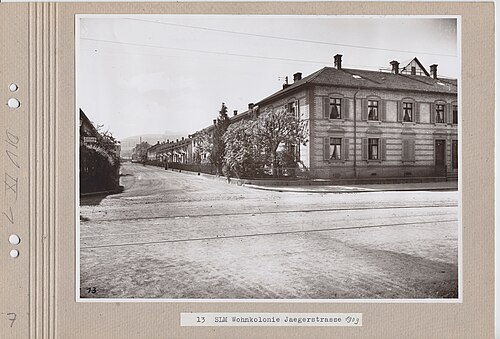

Sources: gebw.ch
1889
Housing shortage and self-help
In the summer of 1889 almost 100 families in Bern are homeless; the city is the first in Switzerland to build flats with tax money. From 1890 middle-class tenants found the first self-help cooperatives: the members build at cost and let the flats to themselves.
Sources: swissinfo.ch
1892
One of Zurich's first building cooperatives
The Zürcher Bau- und Wohngenossenschaft is founded to create and keep healthy, affordable homes.
Sources: zbwg.ch
1907
Zurich starts a housing policy
The city of Zurich starts to promote housebuilding. A hundred years later, in 2007, the city and the housing cooperatives celebrate 100 years of municipal housing policy together.
Sources: mehralswohnen.ch
1916
The ABZ is founded
The Allgemeine Baugenossenschaft Zürich is founded. Today it is one of the city's large housing cooperatives.
Sources: abz.ch
Between the wars 1919–1941
After the First World War the housing shortage returns. The Confederation, cantons and municipalities help with money and land; the umbrella association is founded, and large cooperatives are set up near Basel, in Geneva and in Lausanne.
58 of the listed cooperatives date from this period, together with at least 28'772 flats.
- German-speaking Switzerland: oldest Eisenbahner-Baugenossenschaft Bern (1919); largest Familienheim-Genossenschaft Zürich (FGZ) (2'292 flats)
- Romandie (French-speaking): oldest Société Coopérative d'Habitation Genève (SCHG) (1919); largest Société coopérative d'habitation Lausanne - SCHL (2'319 flats)
For Ticino we found no founding and no decision from this period that a source confirms.
1919
An association and many new cooperatives
The association known today as Wohnbaugenossenschaften Schweiz (Housing Cooperatives Switzerland) is founded. In the same year the Siedlungsgenossenschaft Freidorf in Muttenz, the Société Coopérative d'Habitation Genève and the Eisenbahner-Baugenossenschaft Bern are founded.
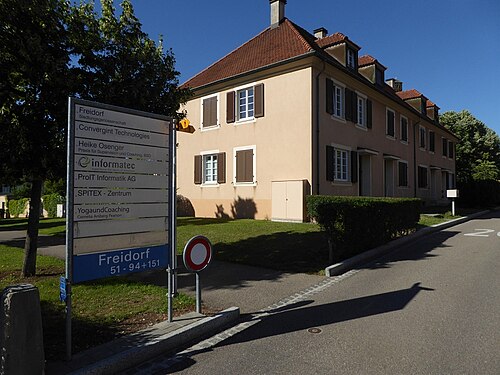

Sources: housinginternational.coop · freidorf-muttenz.ch · schg.ch
1920
A large cooperative in Lausanne
In Lausanne the Société Coopérative d'Habitation Lausanne is founded. Its first project is the Prélaz garden city, built in eight months in 1921, with 60 flats on the city of Lausanne's first building lease.
Sources: vd.ch
1923
The estates of the 1920s
After the First World War there is a housing shortage again. The Confederation, cantons and municipalities help with building grants, cheap loans and land; many building cooperatives are founded, above all in German-speaking Switzerland. In 1923 the village square of the Weissenstein estate in Bern is finished. 41 of the listed housing providers were founded in the 1920s.
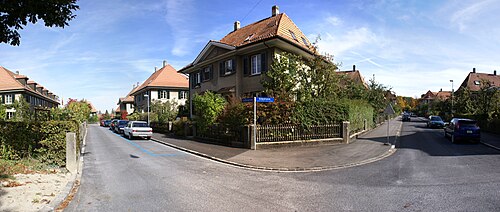

Sources: swissinfo.ch
War, post-war years and the boom 1942–1970
From 1942 the Confederation, cantons and municipalities subsidise housebuilding. After the war the Confederation phases out rent control; cooperatives finance themselves with guarantees and build high-rise estates too. In 1970 the Romandie above all calls for a right to housing.
208 of the listed cooperatives date from this period, together with at least 46'438 flats.
- German-speaking Switzerland: oldest Baugenossenschaft Glattal Zürich (1942); largest FAMBAU Genossenschaft (3'000 flats)
- Romandie (French-speaking): oldest Mon Logis Coopérative d'habitation (1948); largest Logement idéal - Société coopérative (1'532 flats)
1942
Subsidies in the war and after
Between 1942 and 1947 the Confederation, cantons and municipalities support housebuilding with subsidies. 109 of the listed housing providers were founded in the 1940s.
Sources: sg.ch
1955
Tenant protection narrowly rejected
After the war the Confederation extends the wartime rent control for a limited time, aiming to leave housing to the market again. The popular initiative «for the protection of tenants and consumers», which wants to keep price control, fails in 1955 only because a majority of cantons is missing.
Sources: swissvotes.ch
1956
Guarantees for non-profit building
Building cooperatives and banks found the Hypothekar-Bürgschaftsgenossenschaft hbg, a mortgage guarantee cooperative. It guarantees second-rank mortgages so that non-profit buildings can be financed up to 90 per cent of their cost; by 2015 it had supported more than 250 projects.
Sources: bwo.admin.ch
1959
A home for older people in Lugano
From 1959 women's associations in Ticino campaign for a cooperative home for older people. In 1972 the Residenza Emmy opens in Lugano: one- and two-room flats at a moderate rent.
Sources: rsi.ch
1960s
High-rises and large estates
In the 1960s the Eisenbahner-Baugenossenschaft builds the Häberlimatte estate and later more estates and high-rises, so that the flats stay affordable for poorer workers too.
Sources: swissinfo.ch
1970
A right to housing?
The popular initiative «Right to housing and better family protection», launched by the Mouvement Populaire des Familles, narrowly fails with 48.9 per cent yes. More than half of the signatures come from the Romandie; Basel-Stadt, Vaud, Neuchâtel and Geneva vote yes with over 68 per cent.
Sources: swissvotes.ch
A constitutional mandate and new cooperatives 1971–1999
Since 1972 the federal constitution has asked the Confederation to promote housing; the 1974 law and the Fonds de Roulement finance non-profit building, and Vaud gets its own housing law. In the 1980s and 1990s new, often self-managed cooperatives appear in Zurich and Geneva.
82 of the listed cooperatives date from this period, together with at least 11'744 flats.
- German-speaking Switzerland: oldest Baugenossenschaft Udligenswil (1971); largest Stiftung PWG (2'538 flats)
- Romandie (French-speaking): oldest Fondation Rencontre (1975); largest Coopérative Cité Derrière (1'600 flats)
- Italian-speaking Switzerland: oldest Residenza Emmy Società Cooperativa (1972); largest Alloggi Ticino SA (1'376 flats)
1972
Housing promotion in the constitution
With 58.5 per cent and in every canton, voters accept parliament's counter-proposal to promote housebuilding. The popular initiative with a housing fund fails with 28.9 per cent.
Sources: swissvotes.ch
1975
A federal law for affordable housing
The federal law of 4 October 1974 promoting housebuilding and home ownership comes into force, and the Federal Housing Office starts work. In the same year the Fonds de Roulement is created, a federal fund that lends to non-profit builders at low interest.
Sources: bwo.admin.ch · housinginternational.coop
1975
A housing law for Vaud
On 9 September 1975 Vaud gets its housing law (loi sur le logement). With it the canton supports building, renovating and running flats in the public interest; it remains the basis of its housing policy.
Sources: vd.ch
1981
Self-managed houses
In Zurich the Wogeno is founded, in answer to property speculation and out of the political movement of the 1980s. Its residents manage their houses themselves.
Sources: wogeno-zuerich.ch
1990
To the capital market together
The Emissionszentrale für gemeinnützige Wohnbauträger EGW is founded, a cooperative based in Olten. It issues bonds in its own name, on behalf and for the account of its members, so that non-profit builders can borrow on the capital market.
Sources: finews.ch
1994
New cooperatives in the Romandie
In Geneva the Codha is founded, a non-profit cooperative for people who want to live differently: together, and with a say.
Sources: codha.ch
New neighbourhoods and targets since 2000
The Housing Promotion Act of 2003 replaces the old law. Cantons and cities set targets for the non-profit share, Geneva, Zurich and Vaud with their own laws and votes. New cooperatives build whole neighbourhoods.
131 of the listed cooperatives date from this period, together with at least 1'658 flats.
- German-speaking Switzerland: oldest GAWI – Genossenschaftliches Wohnen in Itingen BL (2000); largest Baugenossenschaft mehr als wohnen (158 flats)
- Romandie (French-speaking): oldest Société coopérative de construction et d'habitation B22 (2003); largest Primavesta, société coopérative d'utilité publique (271 flats)
- Italian-speaking Switzerland: oldest Cooperativa abitativa VIV INSEMA (2012)
2003
The Housing Promotion Act
On 1 October 2003 the Housing Promotion Act (Wohnraumförderungsgesetz) comes into force. It replaces the 1974 law and promotes non-profit housebuilding among other things.
Sources: bwo.admin.ch
2007
Geneva: a fifth non-profit
Since 2007 Geneva's law on building non-profit housing (LUP) applies. Today it requires the canton to build and buy until non-profit flats make up 20 per cent of the rental stock.
Sources: silgeneve.ch
2007
Kalkbreite and mehr als wohnen
In June the Kalkbreite cooperative is founded, in December the building cooperative mehr als wohnen, a cooperative of Zurich's cooperatives, marking 100 years of municipal housing policy.
Sources: mehralswohnen.ch · cdn.swiss-arc.ch
2011
One third by 2050
The voters of the city of Zurich write into the municipal constitution that by 2050 one third of all rented flats shall be non-profit, and so affordable.
Sources: stadt-zuerich.ch
2014
Living above a tram depot
From April about 240 people move into the Kalkbreite cooperative's new building, which stands above a tram depot.
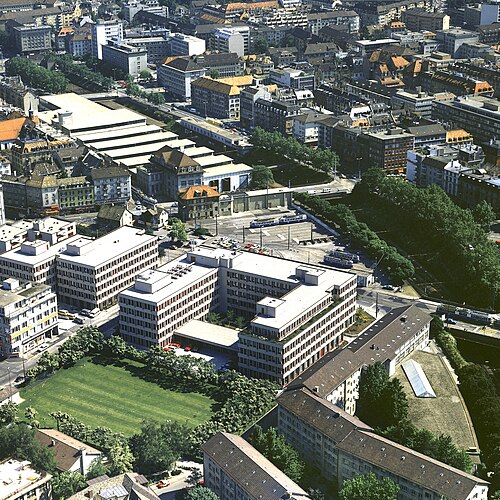

Sources: srf.ch
2015
A neighbourhood of cooperatives
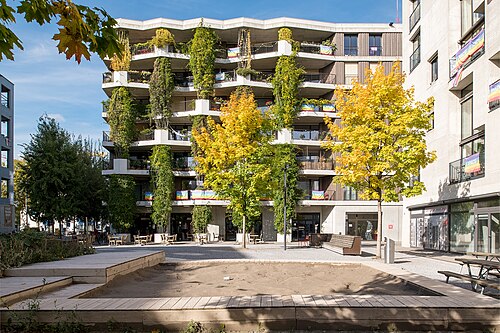
The Hunziker Areal of mehr als wohnen in Zurich is complete: 13 buildings where about 1'200 people live.

Sources: zuerich.com
2017
A section for Italian-speaking Switzerland
The Ticino section of Wohnbaugenossenschaften Schweiz is founded. Cooperatives are rarer in Ticino than in the rest of Switzerland; new ones are being set up in Lugano and the Mendrisiotto.
Sources: cdt.ch
2018
Vaud protects its rented flats
After a popular vote in February 2017, Vaud's law to preserve and promote the rental housing stock (LPPPL) comes into force on 1 January 2018. Among other things it promotes non-profit flats.
Sources: vd.ch
2020
Ten per cent non-profit?
The popular initiative «More affordable homes» wants at least 10 per cent of new flats to be built by non-profit providers. It fails on 9 February 2020 with 42.9 per cent yes; it wins majorities in larger cities and in Basel-Stadt, Geneva, Neuchâtel, Vaud and Jura.
Sources: swissvotes.ch
Today
A small share, a large one in Zurich
About four to five per cent of the flats in Switzerland belong to cooperatives. In the city of Zurich almost a quarter of the flats are non-profit (as of 2019).
Sources: swissinfo.ch